AI Can Draft. It Can Never Be the Author.
There is something happening hundreds of times a day on your team right now, and almost nobody is saying what it is.
Someone opens an AI chat tool, types a prompt, and gets back something usable, like a first draft, a summary, or a reply to a tricky client. Then they make a choice, usually without noticing they made it: do I treat this as a starting point I am responsible for, or do I just pass it along?
That choice, repeated all day, by everyone, is what responsible AI adoption actually is. It's not the policy binder or the governance slide deck that nobody reads. It's that small, constant act of deciding who is responsible for the outputs being created.
Let me be clear about something before anyone reads this as anti-governance. Governance is critical. Policies, guardrails, and the rules about what data goes where and which tools are approved for which work all matter enormously, and any organization that is serious about AI needs to dedicate time, energy, and money to creating the governance foundation that is going to protect the organization and its people. But governance is the floor, not the whole building. It tells people what they are allowed and not allowed to do. It does not, and cannot, make them responsible for how they do it. That part lives with each of us, at that decision point, and no policy document will ever replace this.
Here's the thing. AI can draft, but it can never be the author. Drafting is about getting the words out onto the screen, but authoring is standing behind them. The author is the one who is accountable for what ships, who can defend every claim out loud, and whose name is on the work whether or not it appears in the byline. Tools cannot be accountable. Only humans can.
Here is how it looks in my own practice:
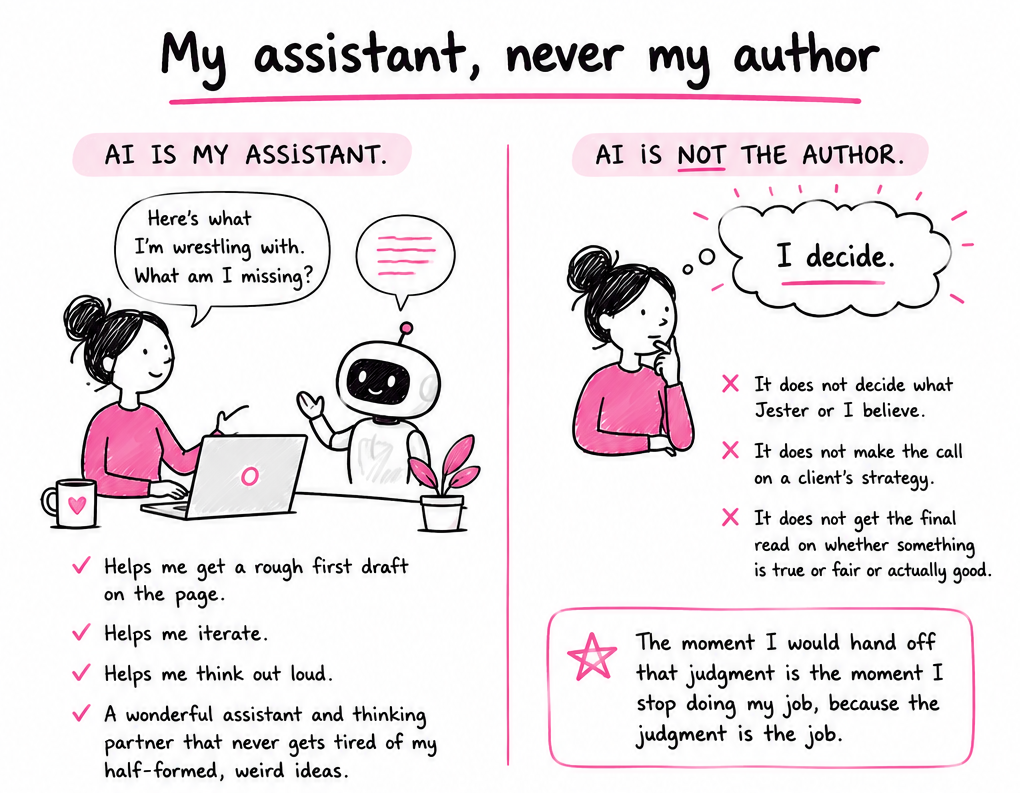
My assistant, never my author
AI is my assistant. I think of it as a smart colleague sitting with me in my home office, someone I can turn to and say, "Here is what I am wrestling with. What am I missing?" It helps me get a rough first draft on the page. It helps me iterate. It helps me think out loud. Lately I do a lot of that thinking by talking, literally speaking my ideas out instead of typing them, because I am finding that saying a thing aloud gives me a clarity that staring at a blinking cursor never quite does. AI tools are wonderful assistants and thinking partners that never get tired of my half-formed, weird ideas.
What it is not is the author. It does not decide what Jester or I believe. It does not make the call on a client's strategy. It does not get the final read on whether something is true or fair or actually good. I do. The moment I would hand off that judgment is the moment I stop doing my job, because the judgment is the job.
Five questions before AI touches my work
So how do you tell the difference, in the moment, with the cursor blinking and the deadline real? You run a few questions before you let AI anywhere near client work. This is the checklist I use, and I would encourage you to make your own version:
Would I put my name on this as if I wrote every word myself?
Is the tool seeing anything my client never agreed to share with it?
Am I using this to think, or to avoid thinking?
Can I defend every claim it just made, out loud, to the client's face?
Where is the human check before this leaves the building?
These are questions of responsibility, and that is the whole point. You can pass every governance rule your company has and still fail every one of these. The rules tell you what is permitted. These tell you whether you are the author or not.
The other half of responsible adoption is often the part people skip: be clear about what you are doing, where the tool is helping you, and where you are letting it take the wheel. It's not a confession or a disclaimer in tiny print, just plain honesty about how the work gets made. The trust you build by being straight about your process with yourself and with others is worth more than the appearance of doing it all by hand. People can tell the difference between a practitioner who uses powerful tools with judgment and one who is hiding behind them
The habits we form right now, in these early, messy, exhilarating days of AI, are the best practices the next wave of people will inherit (remember? Like we did with social media back in the mid 2000s). The norms are not written yet, because they're still being written in every one of those hundreds of small decisions we (and our teams) make in a day. If we build the best practices around accountability, transparency, and integrity, that is the standard that gets passed along to others. If we build them on convenience and half-baked hand-offs, that is what gets passed down instead.
Every time you reach for your AI tool, ask who the author is, and keep the answer pointed firmly at yourself. This isn't a constraint on the work; it IS the work. We have to continue to be the humans in the room, doing the one thing the machine cannot do, which is take responsibility for what you're creating, regardless of the steps you took to get there.
That is the part we will never automate. And at Jester, it is exactly the part we help people get right.
Disclosure: Claude AI was used to ideate and draft this content. Jester authored the post, and we stand behind it. Images were created in collaboration with ChatGPT and Canva.