The Part of Your Job AI Can't Do
This post was inspired by David Armano's recent essay, "The Most Human Person in the Room," published on his Substack, David by Design. Go subscribe to his stuff. Do it now. I’ll wait.
It happens almost every day lately. I'm reading an article in a mainstream publication, something that should be solid, like with an actual masthead behind it, and by the second paragraph, I know something is wrong.
The grammar is fine, and so is the structure. The vocabulary is, if anything, slightly above average, and yet, the piece doesn't land. This is happening more often in mainstream publications that used to know better. The “Publish” button is being hit on pieces that are very obviously written completely by AI.
What I think is really compelling is that AI in and of itself didn't cause this, so what did? Let’s dig in.
The figuring-out layer
There is a layer of marketing and communications work that has never had a good name. It sits between gathering information and producing output, where you decide who you are writing for and what you actually think about the topic. It’s also where you choose what the reader should do with the information you’re sharing. This part of your job often doesn't look like work because most of it happens in your head, on a walk, in a notebook, or in a conversation with a colleague who presents a different viewpoint.
This figuring-out layer is where meaning gets made. Everything before it is gathering. Everything after it is dissemination. Without the figuring-out part in the middle, you are just moving information from one place to another. With it, you are actually saying something original.
For most of communications history, you could not skip the figuring-out layer even if you wanted to, because production mode was slow enough that you had to think while you wrote. The act of putting words on a page forced the figuring out, whether you liked it or not. Writing was thinking.
In the AI era, that coupling has separated. AI can produce a fluent, structured, on-brand draft of almost anything in under a minute. The production layer no longer requires the figuring-out layer to function. Once these things came apart, it became possible, for the first time, to produce communications output without ever actually having to decide what you think.
Yikes.
The tell
Figuring out that something is AI slop by the amount of emdashes, or any of the stylistic fingerprints people are using at the moment to spot AI writing, is one way to do things. But honestly, it’s also pretty easy to tell whether the figuring-out part happened before or after the first draft.
You can feel this when you read something. The piece either has a person behind it who has decided who they are talking to and why, or it doesn't. These decisions are upstream of every sentence. You can sense their presence in the structure, in the choice of evidence, in the way the piece ends. And you can sense their absence, even when every sentence is technically correct.
My side of this
For the last several months, I have been using AI extensively. Not to do all of my writing for me, but to gather. I have built a system that brings me the information I need, organizes it, and surfaces what is relevant to my goals and needs. My library, in other words, is no longer something I go out and assemble. It comes to me, sorted and ready for the figuring out part.
I cannot overstate the positive effect this has had on the way I gather and use information. With my gathering work now mostly outsourced, I can put my actual attention on the part of my job that can’t be done quickly: figuring out what I think. Now I can put more focus on how I shape my arguments, find the evidence that backs my claims, and test whether my position holds. Honestly, it feels like new parts of my brain have been unlocked. The cognitive space that used to go to information collection now goes to meaning-making.
This is what AI looks like when the figuring-out part happens first and the tool serves the thinking and not the other way around. The output, when it comes, is the visible part of a much larger, largely unseen process that AI simply cannot do.
AI needs to be positioned downstream of the meaning-making, not upstream of it.
The same AI tools, used by someone who skips the figuring-out part, produce slop, plain and simple. The gap between those who take the time to do the figuring out first and those who don’t is widening fast.
AI is not a ghostwriter
A ghostwriter takes your topic and produces your draft. A thinking partner takes the seed of an idea and helps you figure out what you actually believe about it, who you are writing for, and what you want them to do with it. By the time you are drafting, the figuring-out is done.
The practice of setting up your own information system is teachable, but without a mindset of “AI as a thinking partner,” the practice does nothing because the practitioner is still treating the AI as a vending machine.
What this means for you
If you are a marketing or comms professional, you already know whether you have been skipping the figuring-out layer. You can see it in the outputs, and newsflash—others can too.
Here is what I ask you to do this week. Before you open an AI tool for your next piece, write one sentence: Who is this for, and what do I want them to do? Then write a second sentence: What do I actually think about this? If you can answer both of those in your own words, in your own voice, before you prompt, you are on the right path to doing the figuring-out. If you can't, your content is not ready for AI yet, no matter how tight the deadline feels.
The figuring-out layer is the part of your job that AI cannot do. It is also, increasingly, the part that matters most.
If you are a communications leader trying to sort out what AI is and isn’t for your organization and what it isn't, that is the conversation Jester is built for.
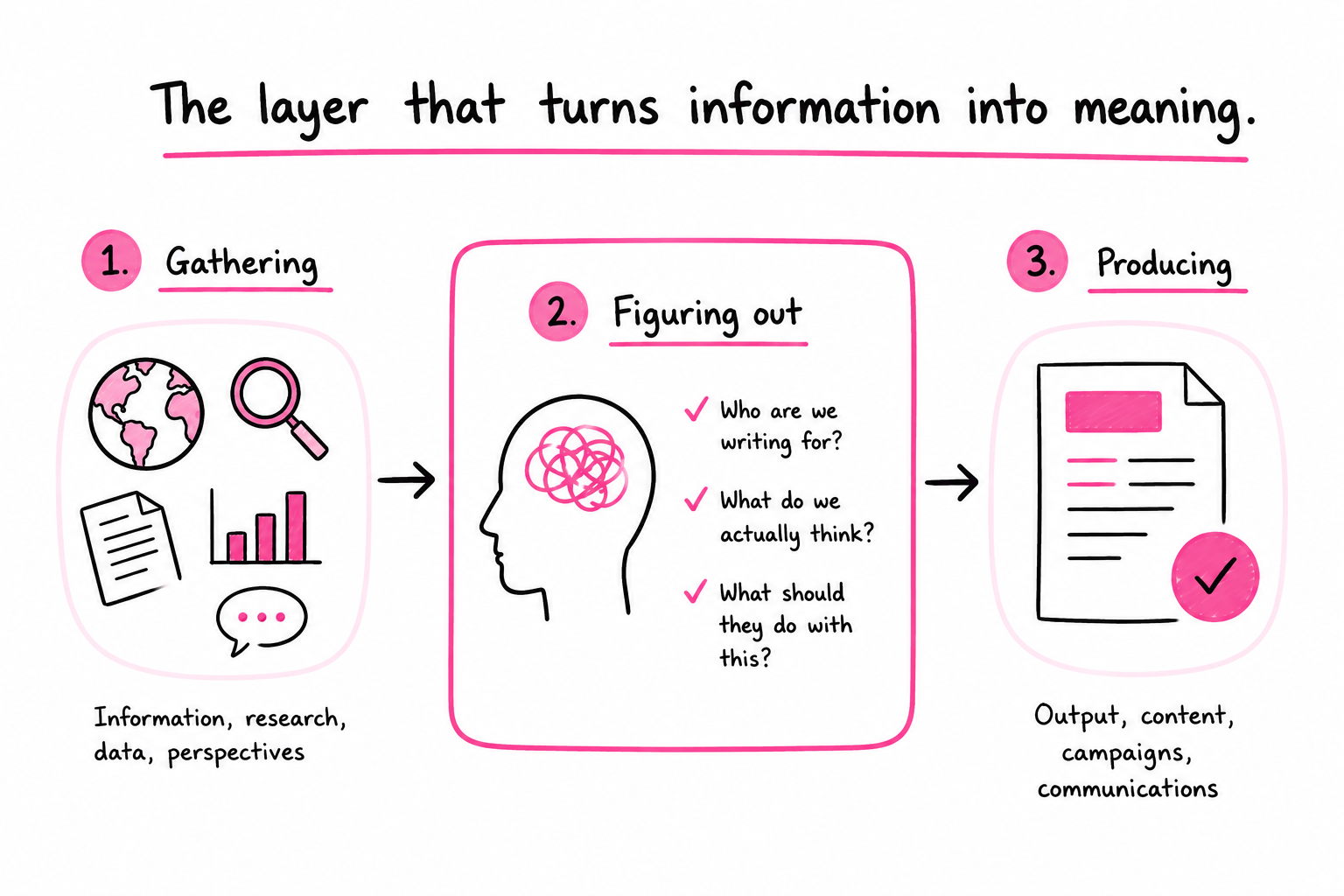
*Image created in collaboration with ChatGPT.